Frequently Asked Questions about Bamboo
Features, Products and Care
FAQ actualizadas: Abril 2026
The plant and its characteristics
Bamboo is a grass, not a tree. It belongs to the grass family, like wheat or maize
Bamboo is, botanically speaking, a giant grass (a herb), belonging to the same family as plants such as wheat or maize. This is the key to many of its properties: it does not undergo secondary growth in thickness (like trees), but its fibrous structure gives it exceptional tensile strength. As it is a grass, its growth cycle is extremely rapid, making it a highly renewable resource.
Yes, provided that its use is controlled and certified. It is one of the fastest-growing plants in the world (some species grow more than 1 metre per day). It captures more CO₂ and produces more biomass per hectare per year than most tree forests. For commercial use, species such as Moso (used in flooring and boards) or Guadua (for structures) are harvested in cycles of 4 to 6 years, without damaging the rhizome, allowing for continuous regeneration of the forest. It is crucial to seek out suppliers, such as Bambusa Estudio, who guarantee a sustainable and traceable source.
You can check the results of the Life Cycle Assessment (LCA) of our Guadua bamboo canes
- Moso Bamboo (Phyllostachys edulis): Native to Asia. It is the species most commonly used for products such as laminate flooring, boards, textiles and fibres. Its canes have a more regular diameter and are well suited to industrial laminating processes. It has excellent surface hardness.
- Guadua Bamboo (Guadua angustifolia): Native to Latin America (especially Colombia and Ecuador). It is the star of structural bamboo. Internationally recognised for its exceptional strength-to-weight ratio and great flexibility, Guadua is ideal for earthquake-resistant constructions, columns, beams and large architectural elements.
Definitely not! Bamboo canes are a natural product, and no two bamboo canes are exactly alike. Each one is different in terms of colour, straightness, taper, wall thickness at the base and tip, and distance between nodes (membranes). Even so, within the same species there are similarities in colour and morphological characteristics.
Guadua canes are characterised by their light brown colour and the random presence of black spots, which may be more or less widespread. These spots are caused by a lichen that attaches itself to the surface of the bamboo when it reaches its optimum maturity. They are therefore not a defect but rather an indication of hardness and that the material has been harvested at its peak.
Products and applications
At Bambusa Estudio, we import the finest bamboo materials, treated and certified to meet the highest standards in the European Community. For consumer products (flooring, cladding, laminated boards), our suppliers guarantee the species (Moso is usually the most common), the type of adhesive (formaldehyde-free) and have sustainability certifications (such as FSC).
Bamboo is suitable for a wide range of applications:
- Main Structures: Houses, pavilions, lightweight roofs, temporary structures, pergolas.
- Secondary Structures: Enclosures, shadings, claddings, railings.
- Interior design: Flooring, interior carpentry (kitchen, stairs) wall panels, bespoke furniture, decorative elements.
- Its use is endorsed by internacional norms (such as ISO 22156) that regulate their design and structural calculation. It is essential that the project be carried out by professionals with specific knowledge of the material.
At Bambusa, we classify bamboo poles by diameter ranges, with tolerances of +/-5mm for sizes up to 50mm and +/-10mm for sizes above 60mm. This allows for uniform installations with poles that are very similar to each other.
Although perfectly straight reeds do not exist, we distribute reeds selected for their straightness and low taper. You can consult the characteristics of each species on our web shop.
Guadua bambo poles stand out for their wall thickness, straightness and low taper.
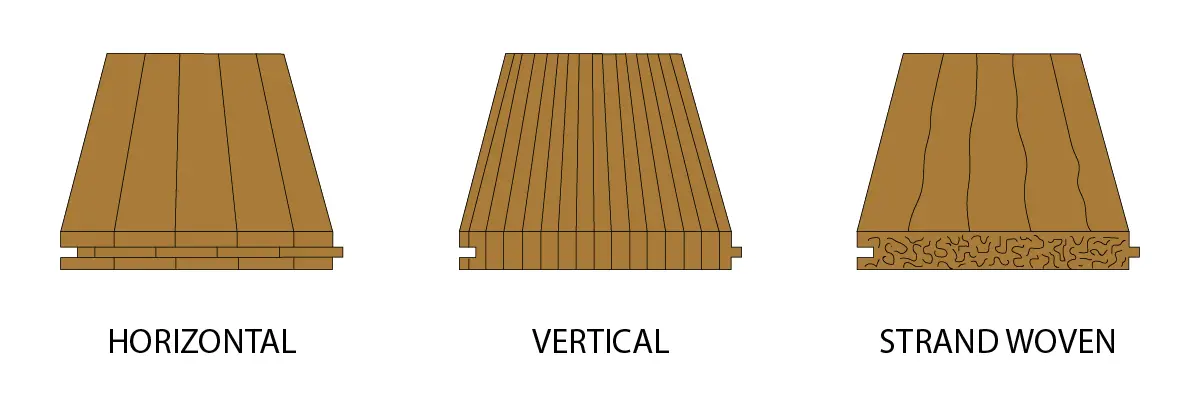
This difference relates to the manufacturing process of multi-layer bamboo products:
- Horizontal: The bamboo strips are laid flat, showing the characteristic "knots". This gives a more natural and traditional look.
- Vertical: The strips are placed on edge, showing the linear fibres. It is usually slightly harder and has a more modern and uniform appearance.
- Strand Woven: Bamboo fibres are shredded, impregnated with resins and pressed at high pressure. The result is an extremely hard material (harder than many tropical woods), ideal for areas with high commercial traffic.
Of course! Bamboo board is an excellent alternative solution, combining the natural warmth and nobility of wood with a hardness superior to that of oak, offering a unique balance of sustainability, warmth and durability that softwoods cannot achieve, at a much lower cost than mineral materials such as quartz and Dekton.
To ensure durability and protection, it is very important to treat the board with specific waterproofing varnishes and to ensure that joints and edges are perfectly sealed.
| Scratch Resistance | Good (harder than hardwoods). Can be scratched by very sharp knives. |
| Environmental impact | Excellent. Renewable resource, low carbon footprint. |
| Cost | Moderate. Similar to mid-high range. Easier installation, does not require specialised professional installation. |
Yes, our Strandwoven flooring are suitable for use in demanding indoor environments, such as high-traffic areas, bathroom floors, and kitchens.
Heat treatment is an industrial process that modifies the structure of bamboo fibre through the application of controlled heat, with the aim of improving its physical and mechanical properties, especially for use in long-lasting products such as flooring, furniture, cladding and decking.
Outdoor Strandwoven decks feature a structure of pressed, glued and heat-treated fibres, making them suitable for outdoor use, promenades, pool areas, etc.
Our Bamboo Fachde claddings are also heat-treated, ensuring durability and stability outdoors, expanding their use in sustainable construction and design.
Durability and Maintenance
Bamboo in its natural state is susceptible to attack by wood-boring insects and to rot due to capillary moisture absorption.
It is very important not to bury bamboo, but to keep it separate from damp soil to prevent water absorption through capillary action. This can be achieved simply by placing a drainage layer between the bamboo and the soil to allow water to drain away (e.g. small stones).
Some varieties, such as Guadua, undergo treatment at source. Immunisation with borax salts is the most common and environmentally friendly method for any technical or long-term use, as it penetrates the fibre and provides lasting protection without being toxic to humans. Properly treated bamboo, such as that processed by experts, can have a lifespan comparable to that of hardwoods.
Yes, over time cracks may appear in the canes. This is a completely natural process linked to the bamboo acclimatising to the humidity of its new home and can occur especially in dry climates and during the first few days after installation.
This factor can only occur in complete rods without affecting the durability of the product, and does not occur in rod sections such as slats or half rods.
If not treated with a water-repellent protective product, moisture may accumulate on the surface of the reeds shortly after installation, especially during the colder months.
This may cause superficial stains to appear. These stains can be removed by washing with pressurised water, possibly mixed with bleach.
Yes, like any untreated wood, natural bamboo exposed to sunlight changes colour. From the green of the living plant, it turns yellow or brown depending on the species as it dries. Exposure to sunlight causes a gradual loss of colour until it turns silver grey.
To maintain or restore the original colour, it can be treated with UV-protective products. The most recommended are oils for tropical woods, such as teak or linseed oil.
Yes. For outdoor use (decking, façades, garden structures), it is advisable to use bamboo that has been specifically treated and sized to withstand the elements. Even so, it is recommended that:
- Periodically apply special outdoor oils or wood stains that repel water and protect against UV rays.
- Design structures with eaves and ventilation to prevent moisture accumulation.
- Do not bury bamboo, but keep it separate from damp soil to prevent water absorption through capillary action. This can be achieved simply by placing a drainage layer between the bamboo and the soil to allow water to drain away (e.g. small stones).
- Conduct annual inspections to maintain the protective finish.
Its maintenance is very similar to that of a hardwood floor:
- Regular cleaning: Sweep or mop with a slightly damp mop. Avoid excess water.
- Cleaning products: Use specific cleaners for wooden floors or pH-neutral cleaners. Avoid abrasive products, ammonia or bleach.
- Protection: Place doormats at entrances and use protectors under furniture legs. Limit direct and prolonged exposure to sunlight to prevent colour changes.
- Re-finishing: v
Yes, humid weather is not harmful to bamboo, but appropriate precautions must be taken. In humid climates, ventilation and protection from direct rain are essential, and above all, avoid the accumulation of standing water. In cold climates with freeze/thaw cycles, it is vital to ensure that moisture does not penetrate and freeze inside the cane. A design that takes into account orientation, protection and construction details is as important as the quality of the material itself.
Customer service
You can contact our customer support team through our contact form, writing to info@bambusa.es, or calling +34 695 092728 Monday to Friday from 9am to 2pm. Our specialist team is available to help you with any queries or problems.
We are committed to providing fast and effective solutions to ensure your satisfaction.
All products have a 14-day return policy from the date of receipt. Items must be in their original condition, unused, and must include the receipt or proof of purchase. Refunds are processed within 5-7 working days after receiving the returned item.
Please check our complete Shippings and returns policy
Our company specialises in the supply of bamboo products and provides expert advice on the design, construction and installation of all the products we offer. We provide personalised support to both private and professional customers. We tailor our services to meet the unique needs of companies in the architecture, landscaping and construction sectors, as well as craftsmen and individuals who want to incorporate bamboo into their projects. *** Translated with www.DeepL.com/Translator (free version) ***
If you are a construction professional, designer, architect, interior designer, or if you have a wholesale business or nursery, please feel free to ask for our B2B policy and special rates for professionals.